
DMAQG Great Show
Another great show by the Des Moines Area Quilt Guild comes to an end. Thank you to all the great customers who are going to be creating awesome artful projects with their purchases!! Great visiting with you all.
14 quilts celebrating friends & family of all ages
Another great show by the Des Moines Area Quilt Guild comes to an end. Thank you to all the great customers who are going to be creating awesome artful projects with their purchases!! Great visiting with you all.

For 19 years we have spent our winter vacation and most recently our winters in retirement at our south Texas oasis. We call it “Manana” because tomorrow is always a day to start or finish another project—whether my sewing and quilting or my husband’s …

Recently I have been sewing quilted projects with neckties and vintage textiles. It does require some different techniques for sewing and quilting with the non-traditional fabrics. The bottom line for sewing with silk and silk-like tie fabrics is that it depends on what your quilted end project is going to be.

Before any sewing can begin with neckties it is imperative to assess the cleanliness. If they are from an unknown source (estate sales, thrift stores, etc), I wash by hand in warm soapy water as soon as I acquire them. I do not remove the interfacing when washing by hand if there is no apparent staining because they tend to have fewer wrinkles as they dry. If there are stains, I usually take the time to remove interfacing so I can better address the stain. Silk ties have a tendency to bleed regardless of their color but polyester ties are usually colorfast. I let drip dry or sometimes air dry in the dryer with no heat. Agitation and tumbling are likely to result in a twisted mass of fabric so I do not machine wash. If you have a mesh bag for fragile or delicate items that could be useful for machine washing. When dry deconstruct the tie saving the label as they make great accents for projects. Both silk and silk-like fabrics can be ironed on the appropriate setting for fiber content.
Ties are cut on the bias of the fabric so are very stretchy as you work with them. I like to stabilize using either Sheer Weight Fusible Pellon or Touch O Gold fusible by HTC. Both of these products maintain the drapability of the silk but keep it from stretching. I can then use the fabric as I would quilters cotton for cutting and sewing (the purple half Dresden). Another alternative I like if I am going to cut shapes for machine applique is to use a paperbacked fusible, Trans-Web. It stabilizes and also helps to prevent raveling while handling.
All the quilted projects with arcs have been treated with paper backed fusible and applied to the background. When doing applique by machine I use a blanket stitch. When ready to quilt I use a walking foot to outline quilt but there is a precaution. Some ties have a very loose weave that can be snagged by the walking foot action. I put a piece of tissue paper over the tie fabric next to, not on top of, the stitching line.
Watch for a pattern spring 2026 designed especially for using ties.


It all started with Covid. I used what I had in the sewing room to create a work that ended up being a lot of purple—or more specifically plum. With the vintage linens and vibrant tones of all things purple it became “Professor Plum in …

Update: May 30 workshop changed to May 29 due to river bridge closure to all traffic. Color By Design Workshop June 12 or 13, 2025 / 9:30am – 3:30pm / $75 Limit: 6 students per session Check out the fabric dyeing workshop I offer …

What will you do to celebrate the spring greens?


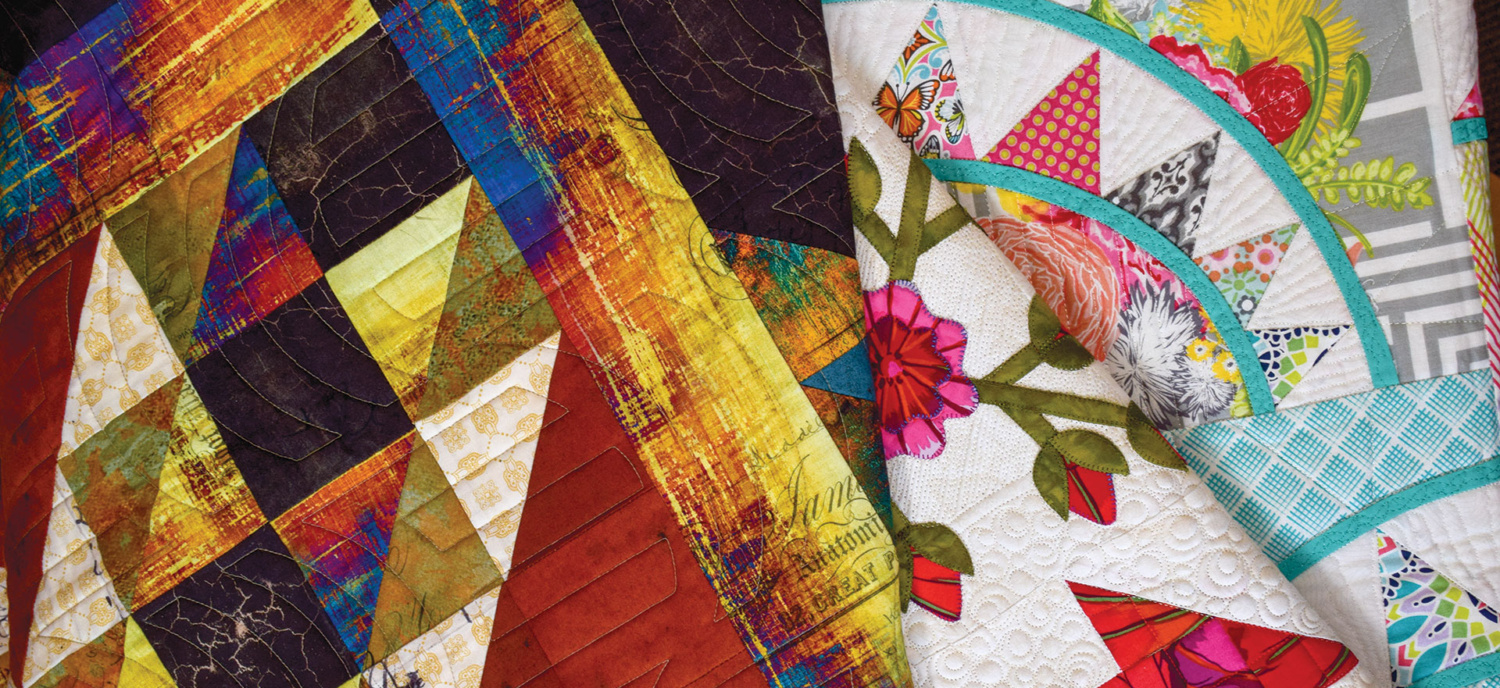
Banded Geese My Way Banded geese is my way of giving a new twist to the traditional Flying Geese block. I did see another version on the internet and tried the method suggested. Having made a lot of FG blocks in the traditional way I …

Texas Treasure I designed a quilt that is featured in the Texas Shop Hop 2025 magazine. I titled it Texas Treasure after one of the two blocks used in the quilt. Texas Treasure quilt block that I chose to use was identified by Nancy …

I set out to make a simple pinwheel quilt so grabbed the specialty ruler and began cutting triangles from the colorful fabric I had selected. I sewed block after block to make the triangle into a square to be pieced. Ready to piece some sample blocks I made a dozen before realizing I had rectangles rather than the intended square blocks. Where did I go wrong?? Oh, grabbed the wrong triangle ruler. Since I was at a retreat I switched to another project (don’t we all have more than one project in our retreat packing). A day went by and it was really bothering me that I couldn’t work on the pinwheel type project. I hate it when a plan doesn’t work but I also know that there is always another solution. The light bulb came on. Cut it up, what could I lose? Rather than cut into halves or quarters I decided to try thirds. An interesting block emerged and it was square when finished. I like rectangle blocks but I had square blocks in my mind.
I moved forward with sewing the rest of the triangles into the rectangle blocks and am ready to start cutting and sewing again. A new block means thinking of a new arrangement and there are so many possibilities. Until I get all the blocks cut and sewn into the new block I’ll continue to reflect on the possibilities.
Quilting mistakes, a challenge and an opportunity.


In May I posted my quilt Patio Pots, but am adding to it for those who may like a little more info. For many years I collected shot cotton stripes with most from the Kaffe Fasset Collective. One rainy spring day when I couldn’t plant …